Written by

Sean Wallace

The bet you're actually making with a safe brand…
Section
Congratulations on the raise.
For the last 12, 18... 24 months, you've been building the product, getting the team right, talking to customers, pitching investors.
But now you now have a much bigger problem than you did then. The world is going to look at your brand — really look at it, for the first time — and decide whether your company is inevitable or interchangeable. Foreordained or fungible. That verdict happens fast, and it happens whether you're ready for it or not.
The brand? It was a placeholder. Something to revisit later, something to hold the site together while the “real” work happened. That was a reasonable call at the time.
The raise changes it.
Now the raise announcement gets shared in group chats and Slack channels. Now the deck gets forwarded. Competitors, journalists, and future hires spend three minutes on your homepage before forming a permanent opinion. And that opinion formed in three minutes - from a brand you spent thirty minutes creating before you sent the pitch deck out - becomes the story of your company for the next twelve months.
Look at what they're seeing. The brand is shorthand for what they all remember you by.
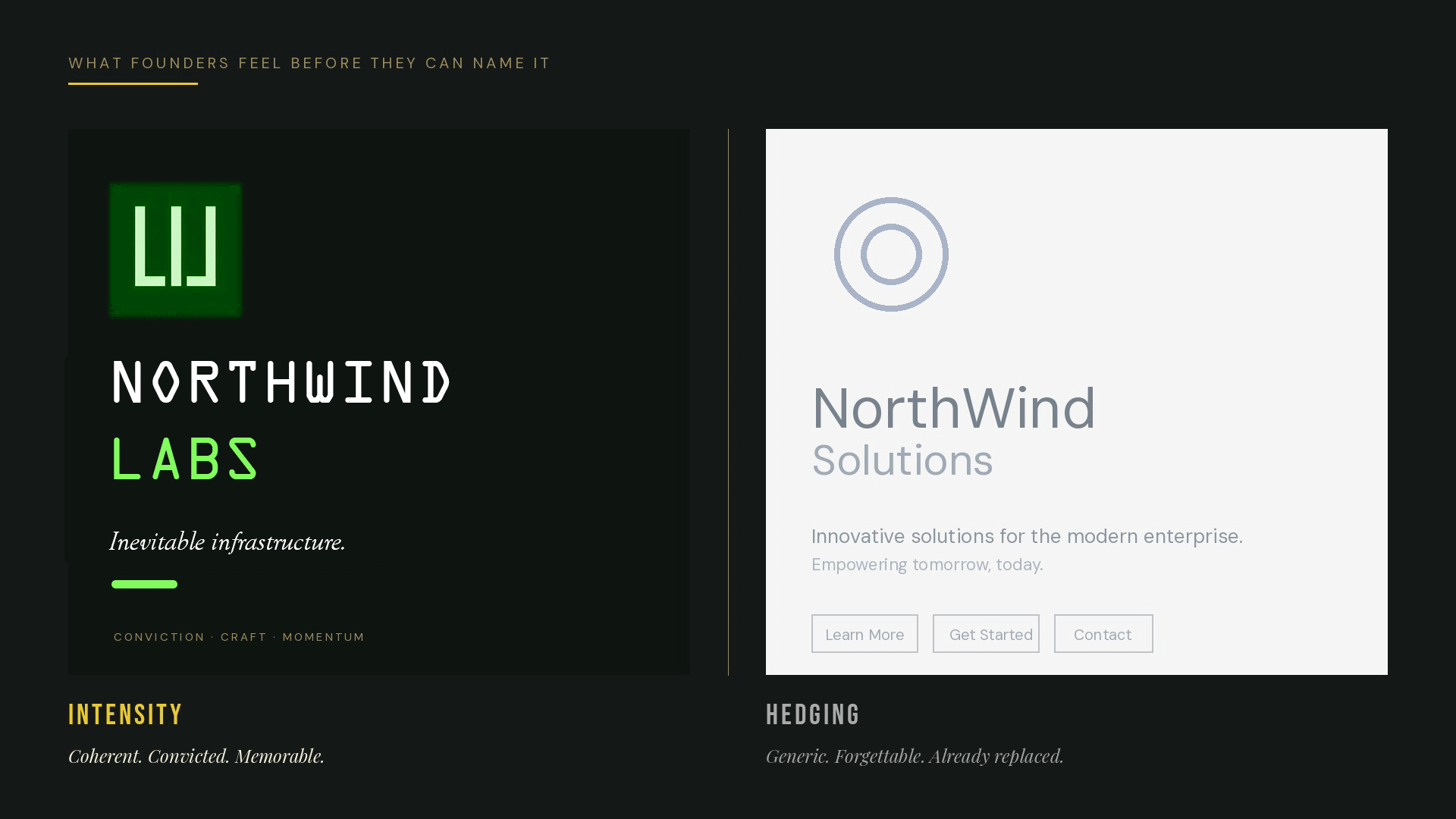
If the color palette was chosen to be “refined,” it was chosen to be forgotten. If the homepage headline could work for a competitor, it's already working for them and not you. A safe brand is the riskiest thing a disruptive founder can own — because safe reads as small and unambitious.
If the logo could belong to any company in your category, so could your future. That leaves a lot up-for-grabs. That seems risky.
The research is unambiguous.
CB Insights analyzed 431 VC-backed startups that shut down since 2023. The leading cause of failure, as it has been for a decade: 43% failed from poor product-market fit, with 14% citing poor marketing as a top contributor.[¹]
"Ran out of cash" — cited by 70% of failed startups — is almost always the symptom, not the disease.
Cash runs out when customers don't convert fast or often enough, when investors pass on the next round, when the market doesn't remember you existed.

Those are brand problems showing up as financial ones. Remember, the brand’s role is always to build value for the company.
Byron Sharp's How Brands Grow, built on decades of research from the Ehrenberg-Bass Institute for Marketing Science, made the point directly: brands don't grow through differentiation. They grow through distinctiveness. Sharp's line is worth remembering: "What marketers should worry about is whether or not their brands are distinctive. Are they easy to recognize and distinguish from others?" [²] A safe brand fails this test on arrival by definition.
McKinsey and Harvard Business Review have quantified what that failure costs. B2B companies with strong brands outperform their peers by 20% in total shareholder return. And 90% of B2B buyers choose from brand selections they've already established before the sales process begins.[³]
Which means: if you're not distinctive enough to be remembered before the conversation starts, you're not in the conversation.
The pattern is consistent. Safe brands don't fail because they're bad. They fail because they're forgettable.
Forgettable is a category of brand failure the research now describes with data and precision.
Three companies that refused to be safe.
Liquid Death took canned water — the most commoditized beverage on earth — and shouted. Metal aesthetic. Death imagery. "Murder your thirst." What Liquid Death understood, and most beverage founders missed: no one was going to notice the water. So they built a brand loud enough that people noticed the water because it had a brand. Valued at over $1B. The product came second. The intensity of the brand came first.
Stripe took payments infrastructure — the most invisible category in B2B software — and made it feel like the future. Precise typography, generous whitespace, editorial polish everywhere. Stripe's brand wasn't loud in the Liquid Death way.
It was intense in the opposite direction: restrained intensity, but no less intense.
The brand made the product credible before the product had a chance to prove itself. After all, it’s infrastructure you can only test after you try, and in the best case is largely invisible. Developers signed up because the brand told them the API would be as good as the marketing suggested. The brand set the user’s expectations in the best way.
Notion took productivity software — the most template-driven category in tech — and made it feel like a movement. Black and white icon system. A tool that aimed to be as useful and flexible as paper — while maintaining minimalist rigor. A visual language that made every other productivity tool look like an annoying spreadsheet. The brand created a specific kind of user who then evangelized the product to their teams. That evangelism was the distribution and it was the brand that brought it to life.
The pattern across all three: the brand carried the vision. The brand didn’t hedge, it unapologetically represented the vision of the company. That's the whole game.
What it costs to stay safe.
Deals close slower because the pitch has to work twice as hard. Talent picks the competitor whose brand feels more like the future. Investors nod politely at demo day and don't remember your company by dinner.
The next round takes longer because momentum leaks between checkpoints. By the time you can afford a rebrand, you're competing against companies who invested earlier — and their brand has been compounding while yours was placeholding.
None of this shows up on a P&L until it's too late to fix cheaply. That's the trap.
The bet you're actually making.
A safe brand is a bet that no one will notice the difference between your company and everyone else in your category.
For a disruptive founder, that's the same bet as: no one will notice you at all.
Your raise says you should be shouting.
Get out there and shout.
Start with the brand.
Sources
[¹] CB Insights, "The Top 12 Reasons Startups Fail," 2024. Analysis of 431 VC-backed shutdowns since 2023.
[²] Sharp, Byron. How Brands Grow: What Marketers Don't Know. Oxford University Press, Ehrenberg-Bass Institute for Marketing Science, 2010.
[³] Sherrard, Saber; Dave, Rishi; MacGregor, Mollie Parker. Harvard Business Review, on B2B brand consideration. McKinsey & Company, The State of Organizations 2023 report on B2B brand outperformance.