For Brands on the Verge of Something Big — A Complete Brand. In a Week. A New Type of Creative Studio.
For Brands on the Verge of Something Big — A Complete Brand. In a Week. A New Type of Creative Studio.
Written by
Sean Wallace
Founders are building the future and presenting it with a brand that betrays it. The cost isn't aesthetic — it's deals, talent, credibility, lost at the exact moment momentum matters.
The market gives founders two bad options — enterprise agencies (template thinking at enterprise prices, six-month timelines) or freelancers (execution, no strategy). Neither was built for a founder in motion.
Restless Voyage is for founders on the verge who know a generic brand will kill their momentum.
In this post:
In this post:
Section
Why I'm building Restless Voyage
I've spent my career working alongside some of the most innovative minds in cutting-edge industries.
Brilliant founders. Genuinely new ideas. The kind of companies that if you understood what they were actually building, would stop you in your tracks.
And the same thing happened almost every time. The brand was an afterthought.
The thinking usually went like this: the best ideas will bubble to the top. Build something great, and customers will love it. Adoption will come, revenue will follow.
Everything else — the brand, the story, the way the company shows up in the world — can be figured out later, once the “real” work is done.
It's an understandable bet, but it's also wrong, and it costs more than most people realize.
What actually happened was this: the brand never told the story of how innovative the product really was. The work was extraordinary and the brand was ordinary. Customers didn't take the company seriously — not because the product wasn't worth it, but because nothing about the brand signaled that it was worth considering.
The brand should always be built for the customer, just like the product.
Here's the part that took me years to fully appreciate. Your customers aren't seeking out brands. They can't tell you what's wrong with the design of your logo or the language you'd use on your website. But they can feel it.
There's an uneasiness that sets in when the pieces of a company don't align — and customers sense it instantly, even if they can't name it.
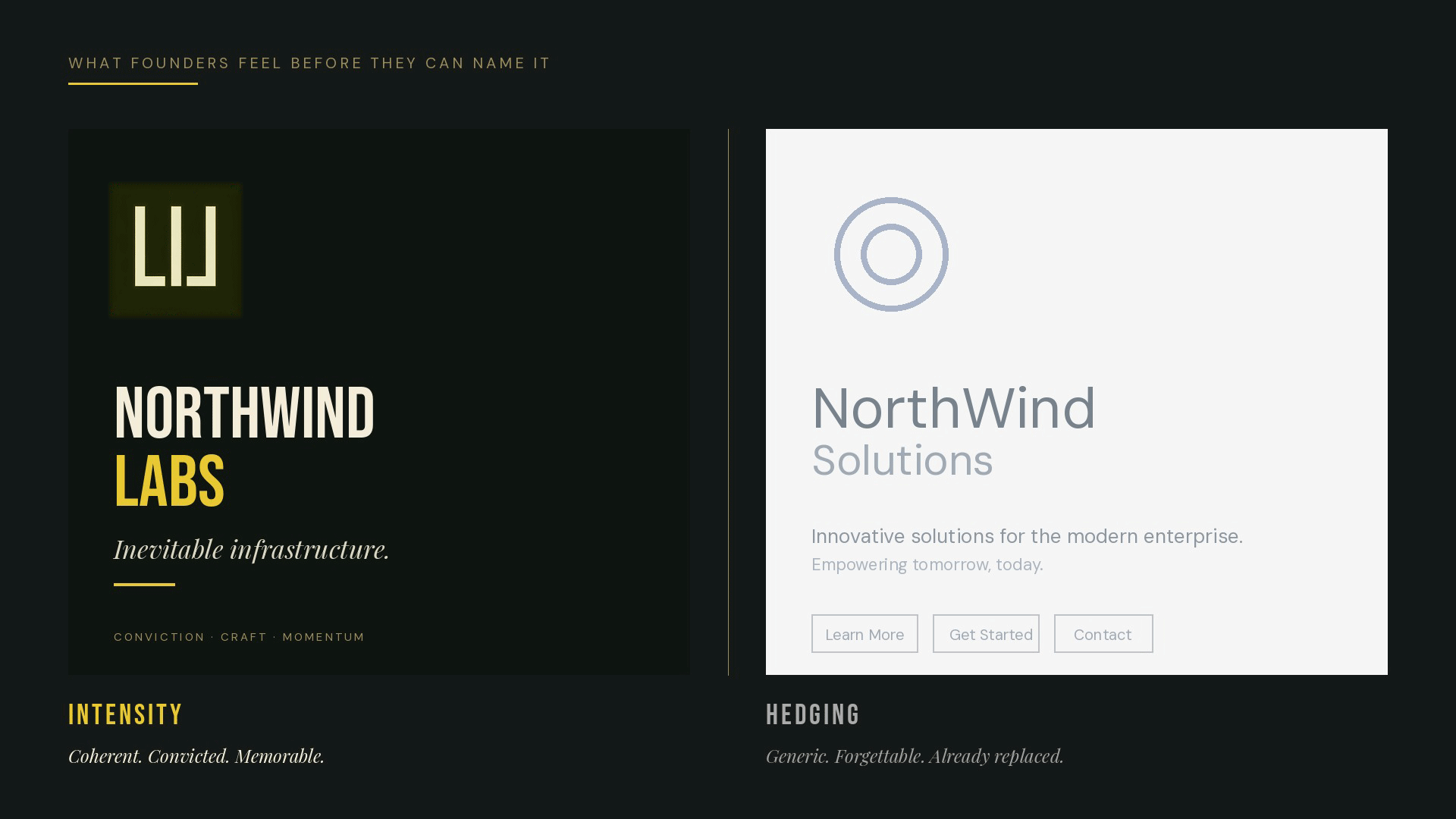
The product experience is sharp and modern, but the marketing website looks like it was built by a different company in a different decade. The founder spouts a bold, world-changing vision on stage, but the support team responds like they're bored and indifferent. The pitch promises a revolution, the onboarding email apologizes in advance for any outages in service. The brand preaches empowerment but the terms and conditions state clearly that you may be commercially exploited.
None of these gaps are fatal on their own. Together, they whisper one thing to every customer, investor, and talent who encounters them: this company doesn't fully know who it is yet.
For a founder trying to look inevitable, that message is louder than any feature list.
The good decision that leads to two bad options
Eventually, most of these companies make the right call. They realize the brand is holding them back, and they decide to fix it — to rebrand, or to build a real brand strategy they never had in the first place.
This is genuinely smart. It's the moment a founder stops treating the brand as decoration and starts treating it as strategic infrastructure.
And it's exactly here that they hit a wall.
When a founder goes looking for help, the market offers two options, and both are bad.
The first is a big agency. Enterprise pricing, timelines measured in quarters. A process that produces template thinking dressed up in a strategy deck. The founder becomes a line item on someone's account spreadsheet, and the work that comes back is competent, safe, and indistinguishable from what the agency delivered to the last ten clients. Worse, the founder who needed to move fast just signed up for six months or more.
The second is a freelancer. Faster, cheaper — but you get execution without strategy. A generic logo, not a brand identity. A website that doesn't know what it's trying to say, because no one did the work of deciding what the company actually stands for before they started picking fonts. An even worse option yet is an AI logo generator.
So the founder chooses the least-bad option for them, gets a brand that still doesn't fit, and ends up right back where they started — except now they've spent money and months they didn't have.
The real problem isn't the agencies or designers. It's the process.
For a long time I assumed the issue was talent, or price, or speed. It isn't. There are brilliant people at agencies and brilliant freelancers. The problem runs deeper than who's doing the work.
The problem is that the entire branding process is built to hedge.
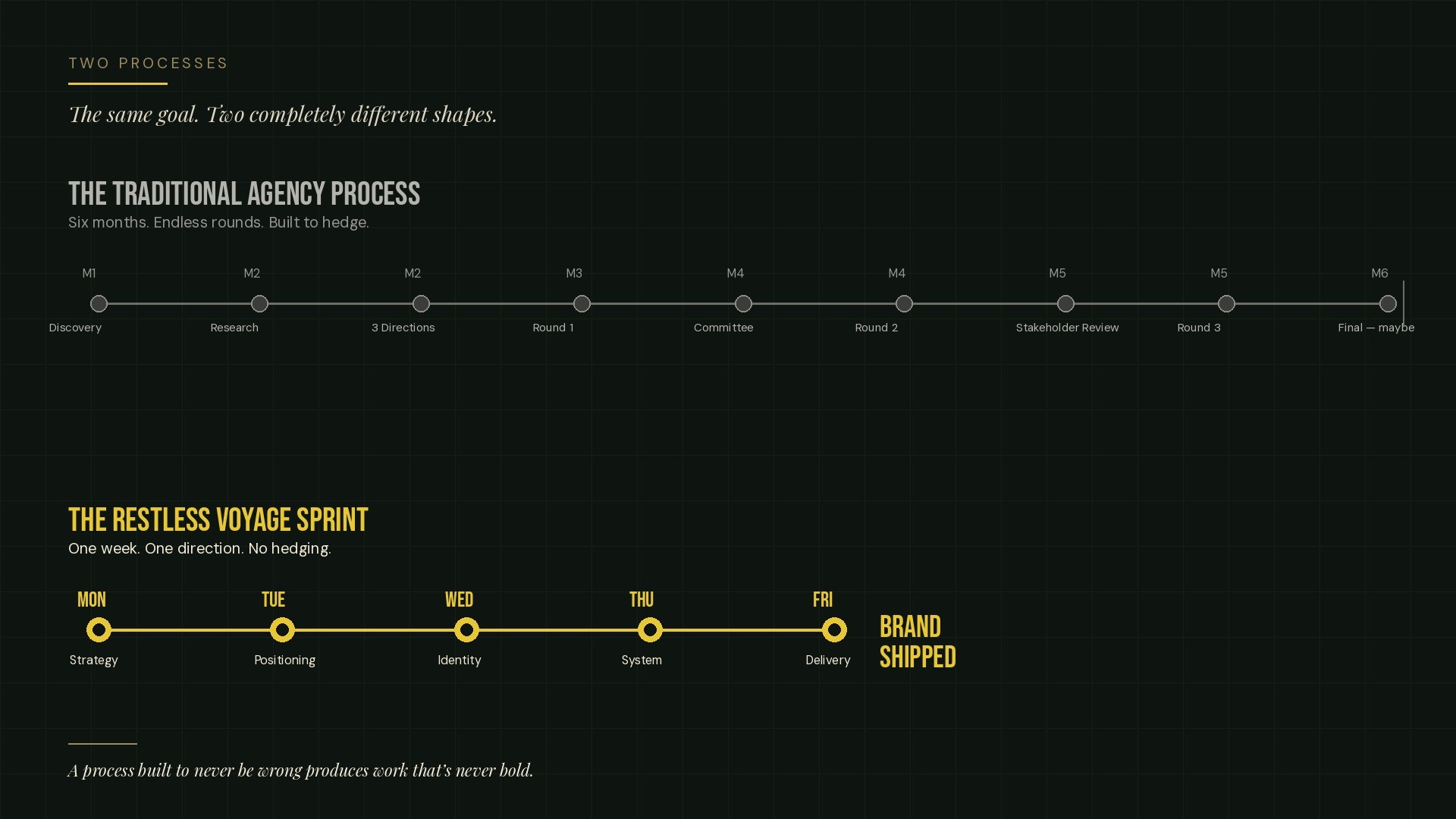
Think about how it actually works. You're presented with three logo directions. You go through endless rounds of revisions. Feedback gets gathered from a committee. The timeline stretches across months with a dozen off-ramps, delays, and check-ins.
Every single step is engineered toward one goal: to avoid being wrong.
A process designed to never be wrong produces work that is never bold.
You can’t hedge your way to a brand that makes someone stop and pay attention. And those three logo options, the long timelines and “collaboration sessions”? They're not generous. They're a confession — that the studio doesn't actually know what is right, so they're quietly handing the hardest decision back to the person who hired them to make it in the first place.
It's hard for true conviction to survive a process like that. Conviction is the entire game. The brands that win don't look careful. They look certain. They look like they were made by people who knew exactly what they were doing and refused to flinch.
That's what I mean by intensity. It isn't a visual style you bolt on at the end. It's a decision you make at the very beginning — to commit to a point of view and build everything around it without apology.
Here’s a secret - in branding there is a best solution. One that expresses the most clear version of the idea it represents.
Brands are long-lasting monuments to creativity – that creativity comes in the form of your novel ideas, innovative products, or disruptive business model.
The intensity of the brand has to match the intensity of the vision behind it. When it doesn't, the brand gets forgotten and so does the company.
The traditional process is structurally incapable of producing that. It's tough business running a marketing agency. Expensive overhead, cyclical client work. When working at agencies, finding clients willing to pay is the main goal.
The work is never going to be bold, because the process was built to make sure it never has to be. The game at agencies isn’t creating the best work, it's maintaining the client relationship to maximize the expensive retainer that customers are paying.
What I built instead
So I built the studio I spent years wishing existed leading marketing at startups or for the founders I worked with. It's called Restless Voyage.
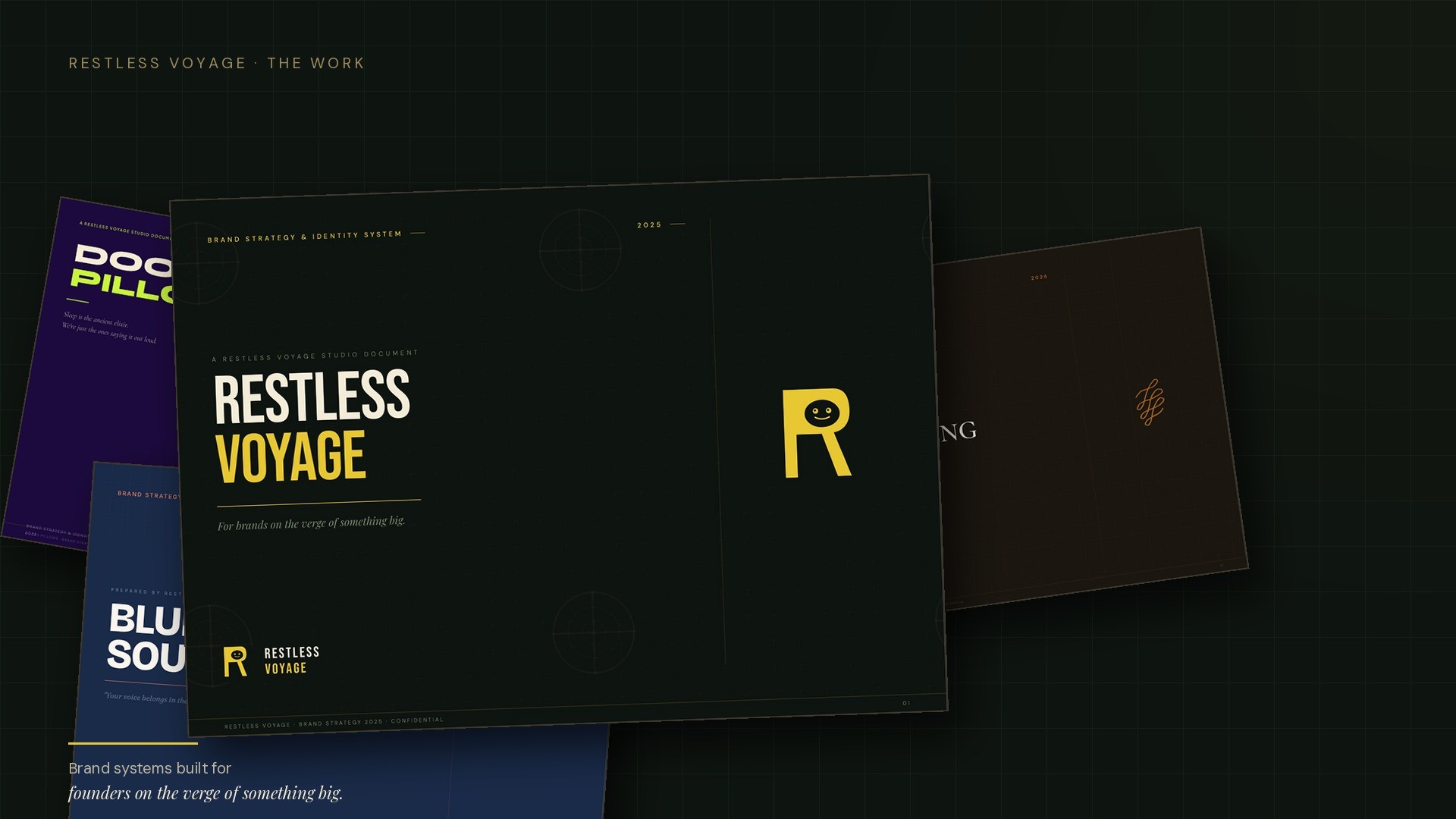
It's a complete brand system — strategy, identity, logo, color, typography, and voice — fully integrated and delivered in a week. For under $5,000.
How it works is deliberate, the entire goal is building a process to create bold brands.
Clear brand concepts. I do the hard work of deciding what's right, building out a full concept that’s bold, and I stand behind it. You're paying for an answer, not a menu of options that pushes the decision back onto you.
One week, not six months. Founders move fast. Their brand should move at the same speed — without cutting a single corner. Speed and quality aren't opposites when you know what you're doing.
No sales calls. I won’t bore you with weeks of intro meetings, project scoping, flimsy timelines, or price adjustments. Everything you need in order to decide is already public — how the process works, how we think, the work itself. When you're ready, you fill out the intake and we begin. No gatekeeping, no pressure, no calendar gymnastics.
Speed is intensity. A brand concept grounded in strategy is conviction.
Skipping the sales call takes trust out of the equation when our process, philosophy and work is transparent. We don’t promise the world on a sales call and underdeliver once you sign on the dotted line.
None of it is a compromise. It's the model, top to bottom — a branding process as bold as the brands it's meant to create.
This isn't for everyone, and it's not supposed to be. It's for founders on the verge of something big — the ones who already know that a generic, forgettable brand will quietly kill their momentum at the exact moment it matters most. The ones building something the world can't quite see yet, because the brand isn't showing it.
If that's you, I'd like to help you finally look like the company you already know you're building.
The intensity of your brand should match the intensity of your vision.
Let's make it undeniable.
Start your brand project here → https://restlessvoyage.com/start
Why I'm building Restless Voyage
I've spent my career working alongside some of the most innovative minds in cutting-edge industries.
Brilliant founders. Genuinely new ideas. The kind of companies that if you understood what they were actually building, would stop you in your tracks.
And the same thing happened almost every time. The brand was an afterthought.
The thinking usually went like this: the best ideas will bubble to the top. Build something great, and customers will love it. Adoption will come, revenue will follow.
Everything else — the brand, the story, the way the company shows up in the world — can be figured out later, once the “real” work is done.
It's an understandable bet, but it's also wrong, and it costs more than most people realize.
What actually happened was this: the brand never told the story of how innovative the product really was. The work was extraordinary and the brand was ordinary. Customers didn't take the company seriously — not because the product wasn't worth it, but because nothing about the brand signaled that it was worth considering.
The brand should always be built for the customer, just like the product.
Here's the part that took me years to fully appreciate. Your customers aren't seeking out brands. They can't tell you what's wrong with the design of your logo or the language you'd use on your website. But they can feel it.
There's an uneasiness that sets in when the pieces of a company don't align — and customers sense it instantly, even if they can't name it.
The product experience is sharp and modern, but the marketing website looks like it was built by a different company in a different decade. The founder spouts a bold, world-changing vision on stage, but the support team responds like they're bored and indifferent. The pitch promises a revolution, the onboarding email apologizes in advance for any outages in service. The brand preaches empowerment but the terms and conditions state clearly that you may be commercially exploited.
None of these gaps are fatal on their own. Together, they whisper one thing to every customer, investor, and talent who encounters them: this company doesn't fully know who it is yet.
For a founder trying to look inevitable, that message is louder than any feature list.
The good decision that leads to two bad options
Eventually, most of these companies make the right call. They realize the brand is holding them back, and they decide to fix it — to rebrand, or to build a real brand strategy they never had in the first place.
This is genuinely smart. It's the moment a founder stops treating the brand as decoration and starts treating it as strategic infrastructure.
And it's exactly here that they hit a wall.
When a founder goes looking for help, the market offers two options, and both are bad.
The first is a big agency. Enterprise pricing, timelines measured in quarters. A process that produces template thinking dressed up in a strategy deck. The founder becomes a line item on someone's account spreadsheet, and the work that comes back is competent, safe, and indistinguishable from what the agency delivered to the last ten clients. Worse, the founder who needed to move fast just signed up for six months or more.
The second is a freelancer. Faster, cheaper — but you get execution without strategy. A generic logo, not a brand identity. A website that doesn't know what it's trying to say, because no one did the work of deciding what the company actually stands for before they started picking fonts. An even worse option yet is an AI logo generator.
So the founder chooses the least-bad option for them, gets a brand that still doesn't fit, and ends up right back where they started — except now they've spent money and months they didn't have.
The real problem isn't the agencies or designers. It's the process.
For a long time I assumed the issue was talent, or price, or speed. It isn't. There are brilliant people at agencies and brilliant freelancers. The problem runs deeper than who's doing the work.
The problem is that the entire branding process is built to hedge.
Think about how it actually works. You're presented with three logo directions. You go through endless rounds of revisions. Feedback gets gathered from a committee. The timeline stretches across months with a dozen off-ramps, delays, and check-ins.
Every single step is engineered toward one goal: to avoid being wrong.
A process designed to never be wrong produces work that is never bold.
You can’t hedge your way to a brand that makes someone stop and pay attention. And those three logo options, the long timelines and “collaboration sessions”? They're not generous. They're a confession — that the studio doesn't actually know what is right, so they're quietly handing the hardest decision back to the person who hired them to make it in the first place.
It's hard for true conviction to survive a process like that. Conviction is the entire game. The brands that win don't look careful. They look certain. They look like they were made by people who knew exactly what they were doing and refused to flinch.
That's what I mean by intensity. It isn't a visual style you bolt on at the end. It's a decision you make at the very beginning — to commit to a point of view and build everything around it without apology.
Here’s a secret - in branding there is a best solution. One that expresses the most clear version of the idea it represents.
Brands are long-lasting monuments to creativity – that creativity comes in the form of your novel ideas, innovative products, or disruptive business model.
The intensity of the brand has to match the intensity of the vision behind it. When it doesn't, the brand gets forgotten and so does the company.
The traditional process is structurally incapable of producing that. It's tough business running a marketing agency. Expensive overhead, cyclical client work. When working at agencies, finding clients willing to pay is the main goal.
The work is never going to be bold, because the process was built to make sure it never has to be. The game at agencies isn’t creating the best work, it's maintaining the client relationship to maximize the expensive retainer that customers are paying.
What I built instead
So I built the studio I spent years wishing existed leading marketing at startups or for the founders I worked with. It's called Restless Voyage.
It's a complete brand system — strategy, identity, logo, color, typography, and voice — fully integrated and delivered in a week. For under $5,000.
How it works is deliberate, the entire goal is building a process to create bold brands.
Clear brand concepts. I do the hard work of deciding what's right, building out a full concept that’s bold, and I stand behind it. You're paying for an answer, not a menu of options that pushes the decision back onto you.
One week, not six months. Founders move fast. Their brand should move at the same speed — without cutting a single corner. Speed and quality aren't opposites when you know what you're doing.
No sales calls. I won’t bore you with weeks of intro meetings, project scoping, flimsy timelines, or price adjustments. Everything you need in order to decide is already public — how the process works, how we think, the work itself. When you're ready, you fill out the intake and we begin. No gatekeeping, no pressure, no calendar gymnastics.
Speed is intensity. A brand concept grounded in strategy is conviction.
Skipping the sales call takes trust out of the equation when our process, philosophy and work is transparent. We don’t promise the world on a sales call and underdeliver once you sign on the dotted line.
None of it is a compromise. It's the model, top to bottom — a branding process as bold as the brands it's meant to create.
This isn't for everyone, and it's not supposed to be. It's for founders on the verge of something big — the ones who already know that a generic, forgettable brand will quietly kill their momentum at the exact moment it matters most. The ones building something the world can't quite see yet, because the brand isn't showing it.
If that's you, I'd like to help you finally look like the company you already know you're building.
The intensity of your brand should match the intensity of your vision.
Let's make it undeniable.
Start your brand project here → https://restlessvoyage.com/start
For brands on the verge of something big.
Speed is intensity. Brand identity rooted in conviction. Tied to real strategy.